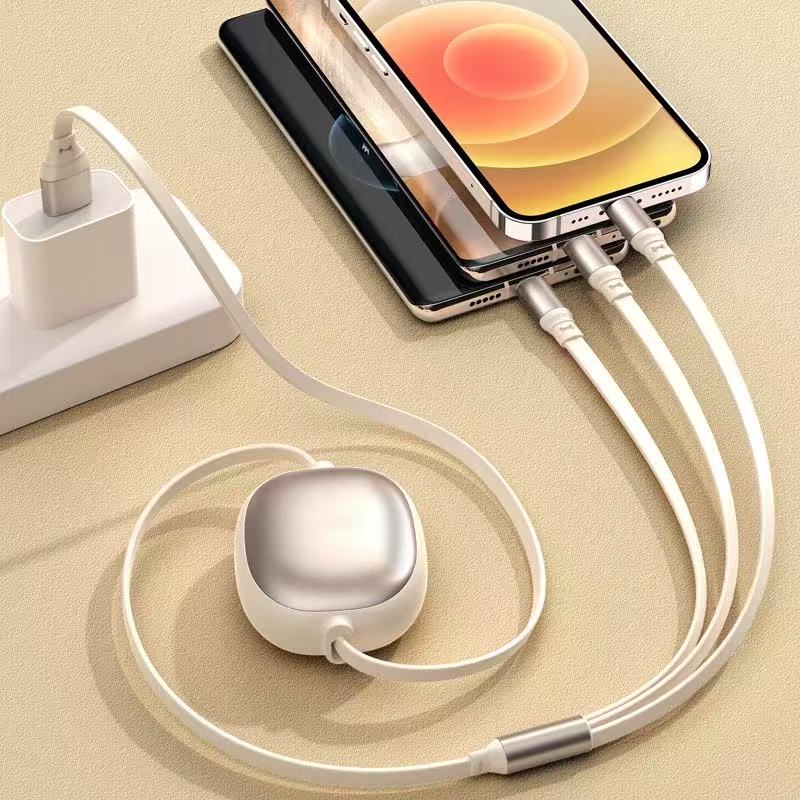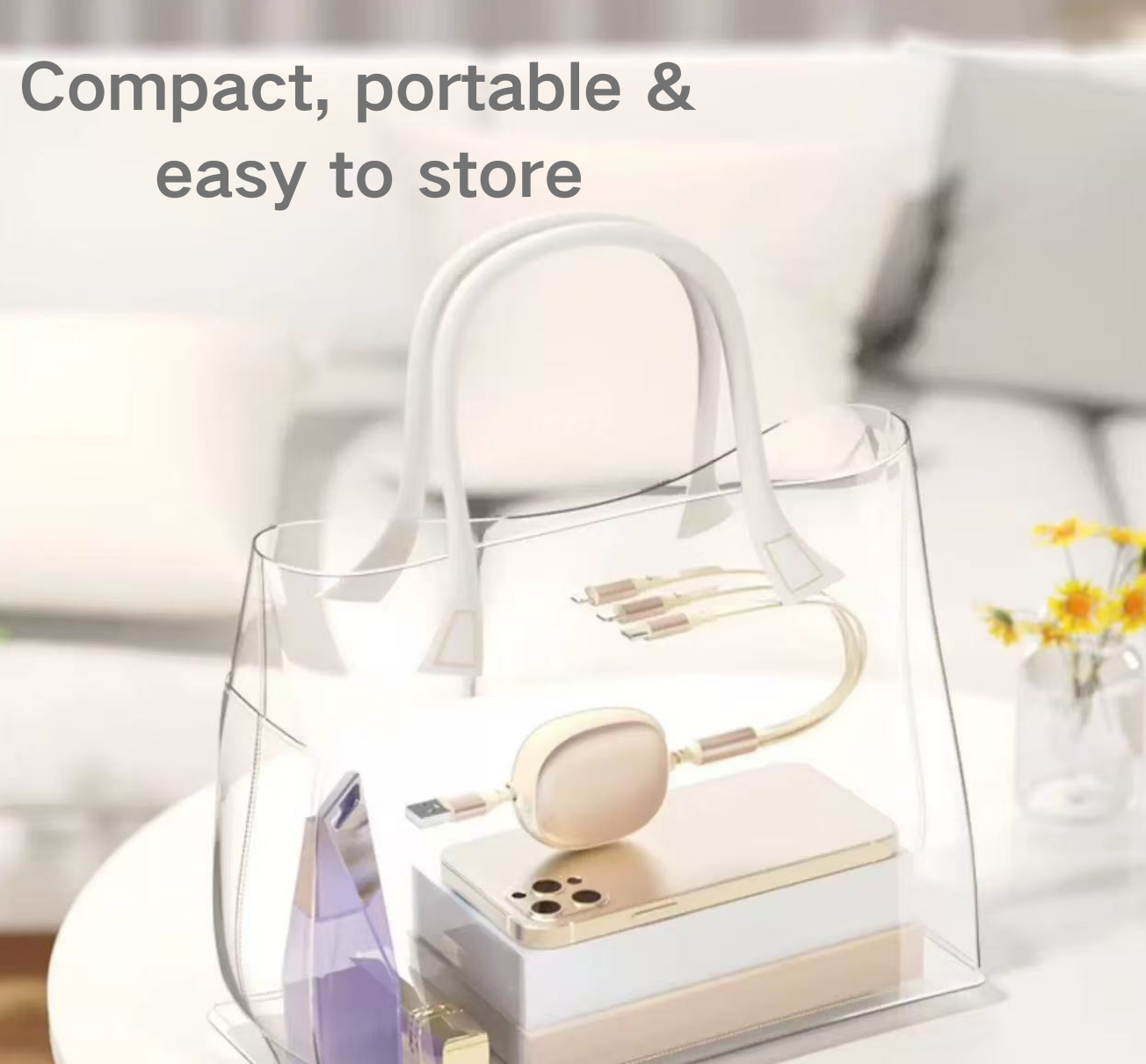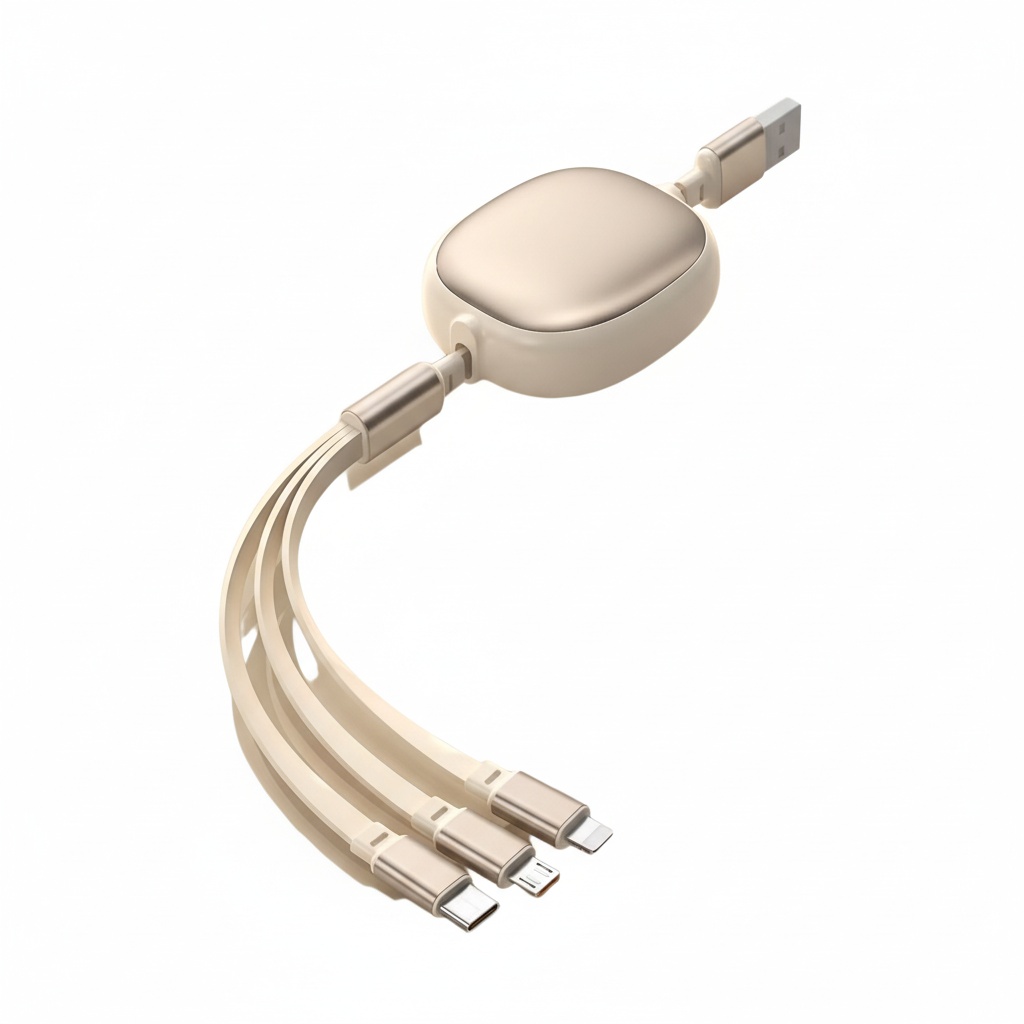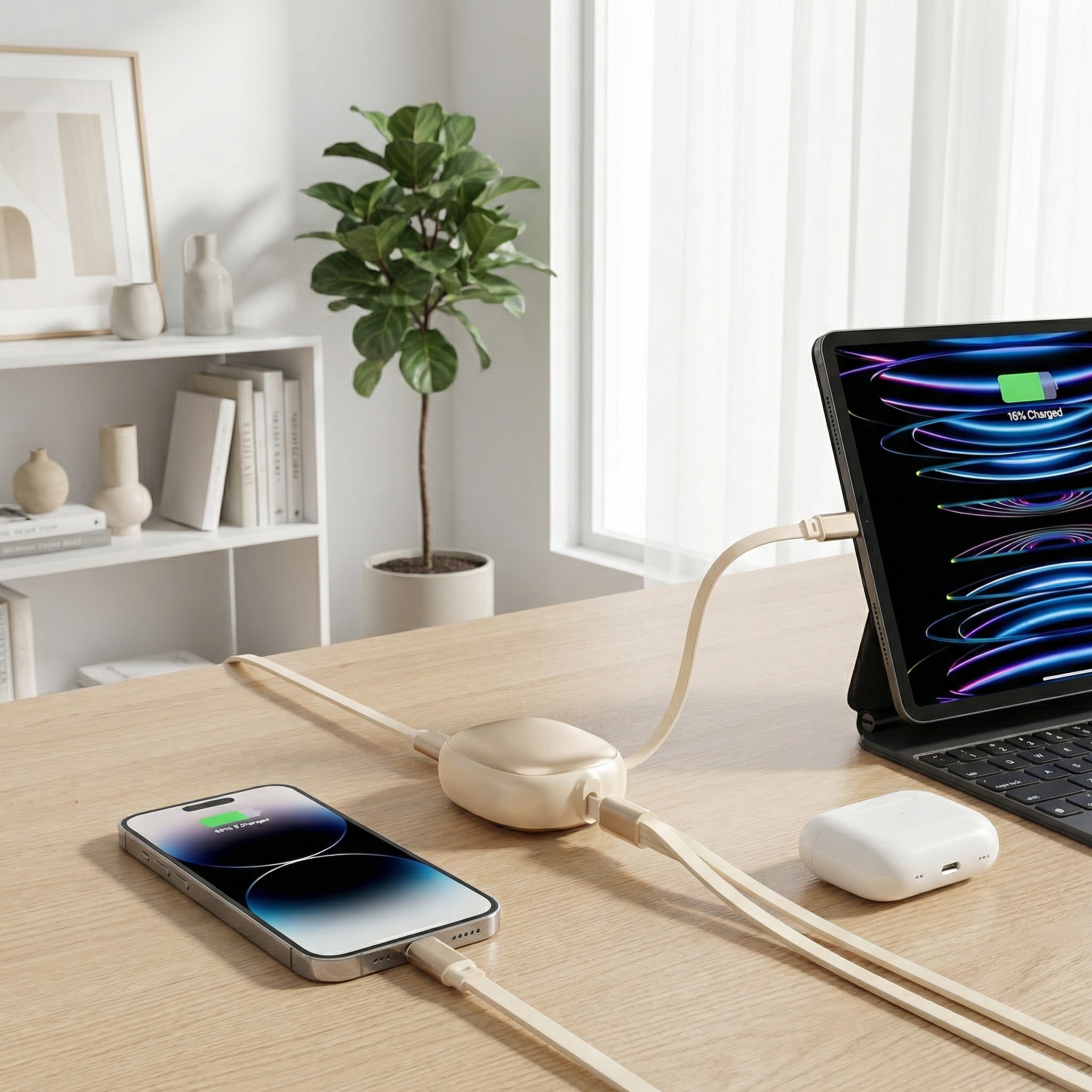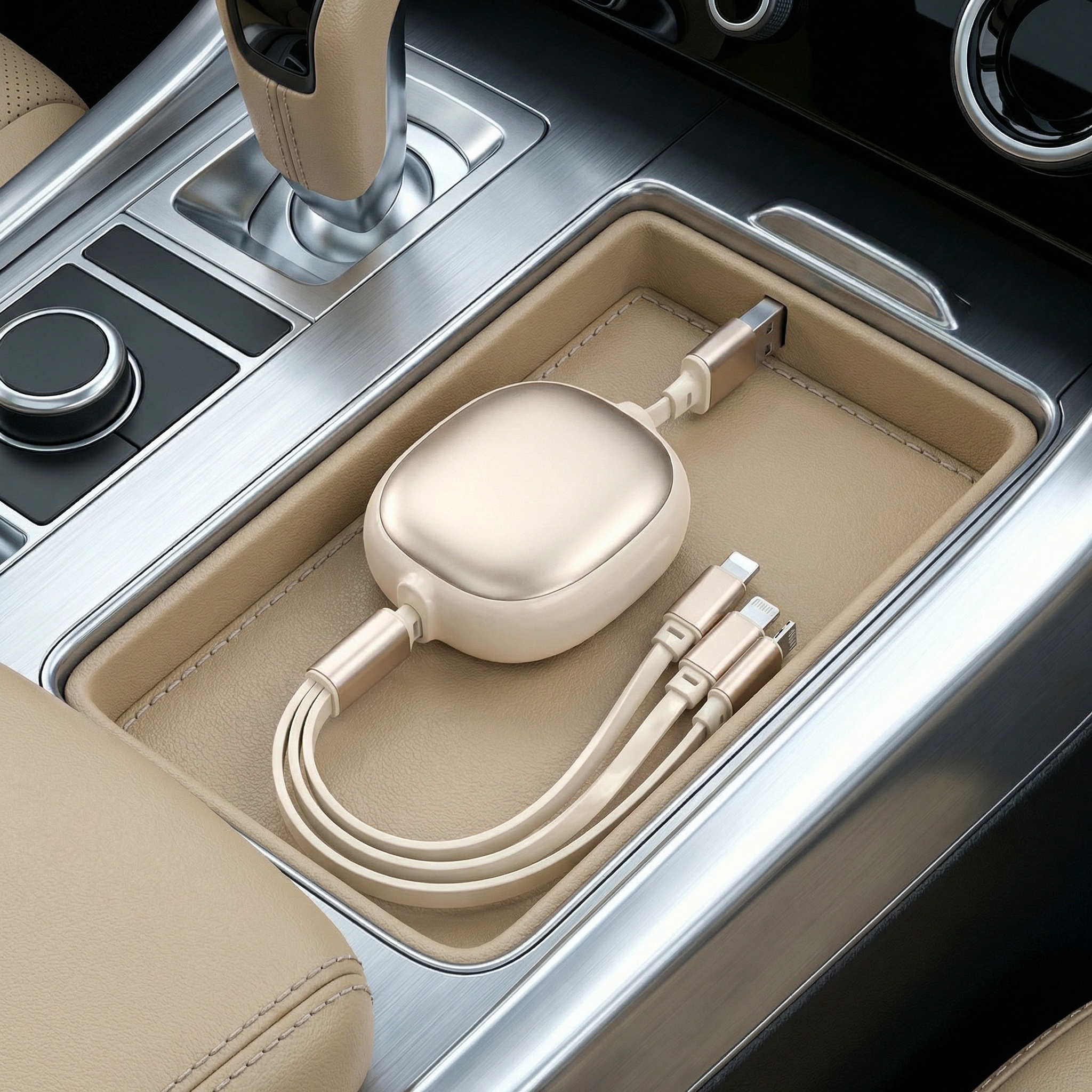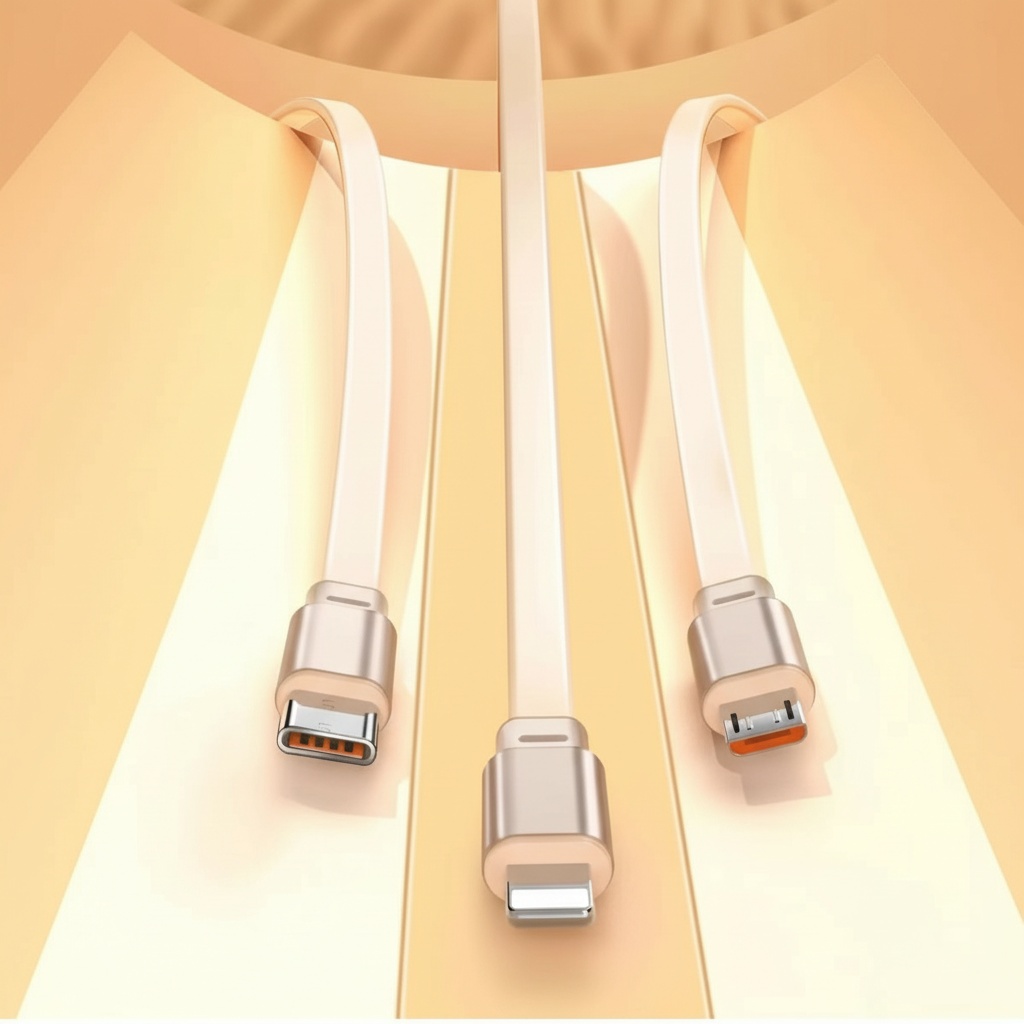
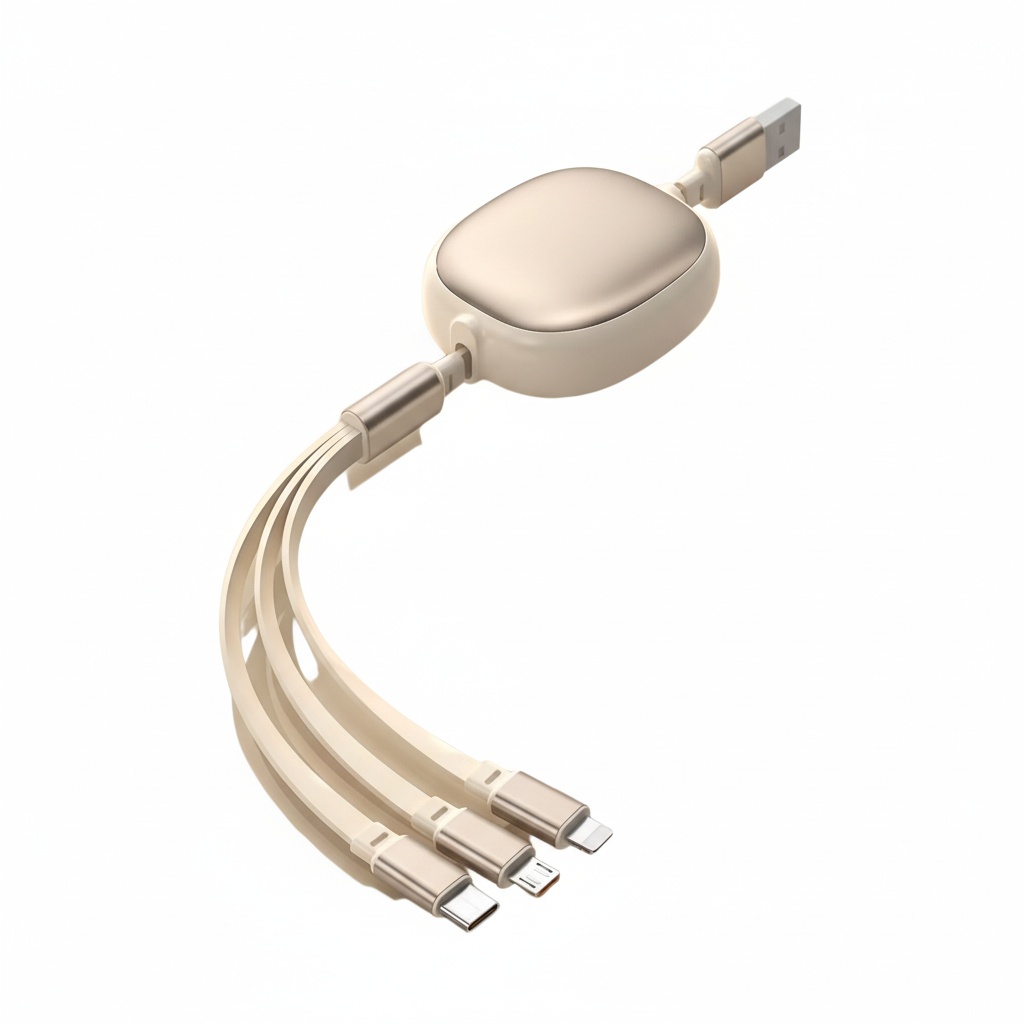
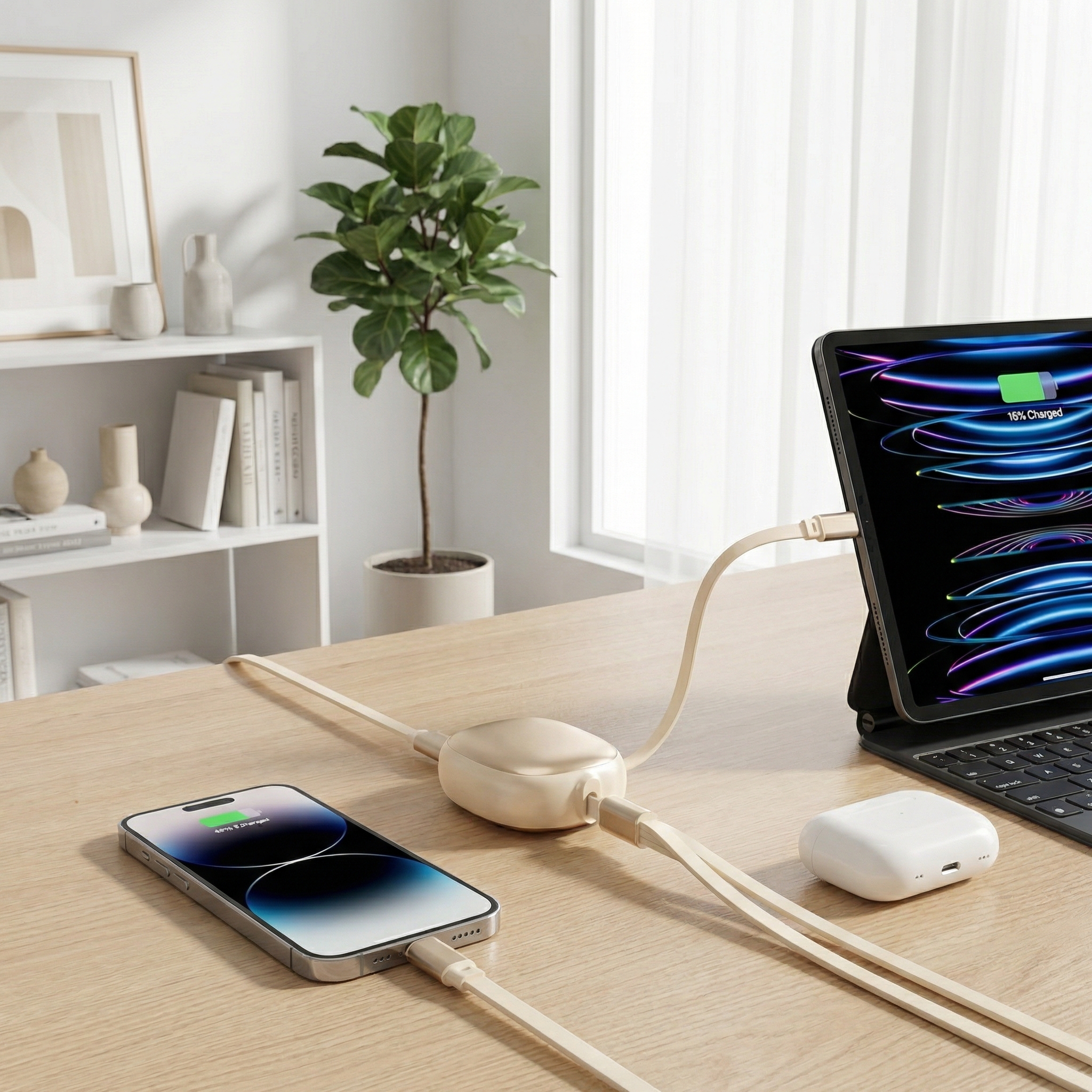
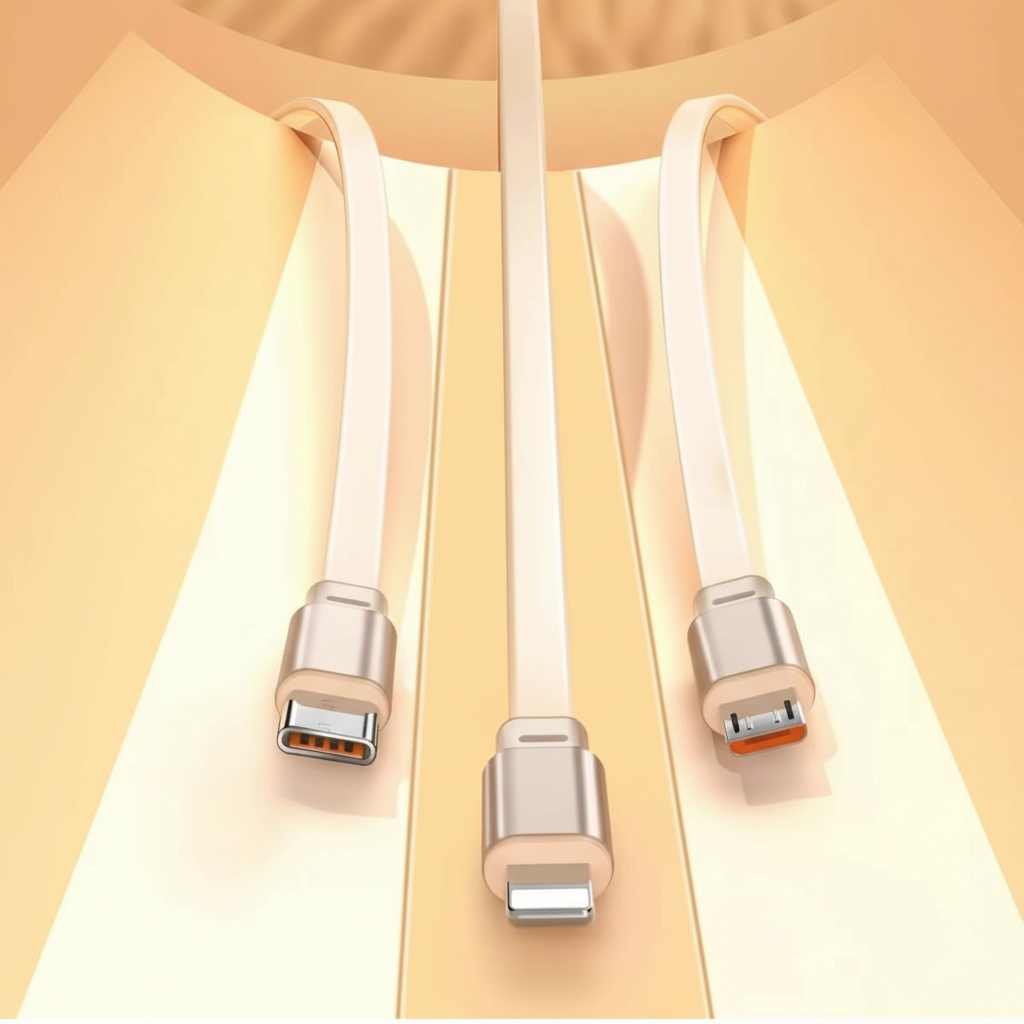
Key Features: • 3-in-1 design: Lightning, Type-C & Micro-USB connectors • Five-gear retractable cable length (up to 1.2m) • Compact & portable storage case, tangle-free • Supports charging for most smartphones & devices • Durable construction for long-lasting use • Large area for logo branding & customization • Perfect for travel, office, and promotional gifts
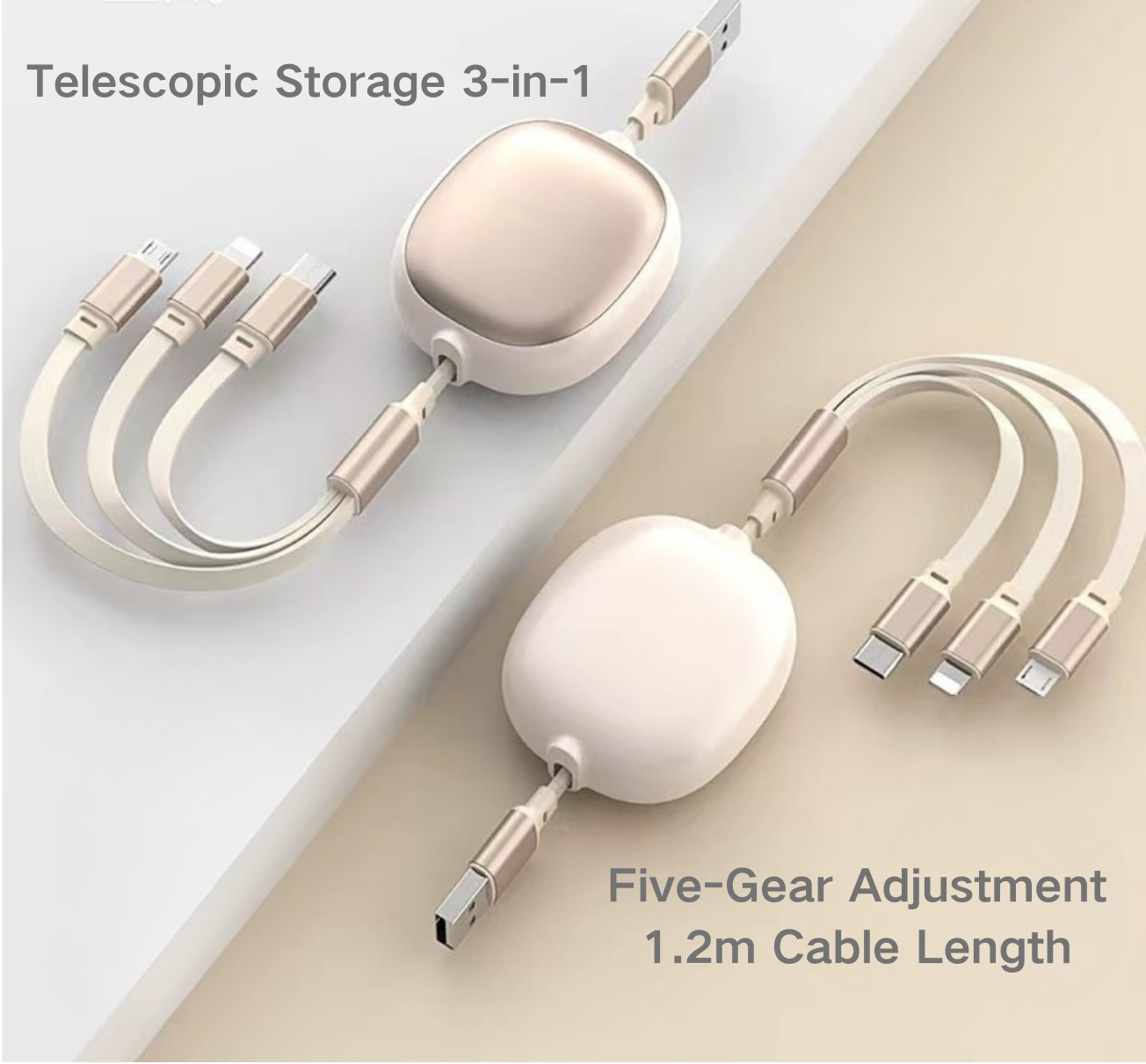
Three connectors, one housing, fewer cables in the drawer. The 3 in 1 retractable charging cable puts a Lightning tip, a Type-C tip and a Micro-USB tip on a single split head, so one unit covers an iPhone, an Android handset, a tablet, a headset or a power bank without anyone hunting for the right lead. The tips sit side by side on a short branched tail and are pulled out as the device requires.
When the job is done the cable winds back into a compact oval hub. Rather than a loose coil that tangles in a bag, the length is set through five geared positions, from a short loop that suits a socket beside the desk out to the full extension for a floor box or a car console. A silicone sheath keeps the cable supple through repeated winding, and since the same lead carries data, a phone can be synced from a laptop without a second cable.
As a 3 in 1 charging cable supplier, we hear the same request from most buyers: their people carry more than one type of device, and stocking a separate lead for each one is wasteful. One part number covers the mix, which keeps a support desk, a travel kit or a welcome pack simple to assemble and easy to replenish.
- One item per person — a single cable covers the phone, the tablet and the headset, so an issue desk hands over one thing instead of three. - Nothing to misplace — the tips are captive on the split head, so there is no adapter to leave in a meeting room or a hotel socket. - A length that stays put — once set, the run stays at that reach between charges, which keeps shared desks and meeting tables clear. - A panel built for a real logo — a custom logo charging cable only works if the mark is legible, and the flat face of the hub takes a company name at a size people can actually read. - Two jobs on one lead — charging and data on the same connection means one fewer cable in a technician's pouch. - Easy to brief — the specification is short and fixed, which makes it simple to place in a catalogue page, a gift proposal or an internal kit list without a second round of questions.
Retractable Mechanism and Housing
The working part of the cable is a spring-loaded hub with a five-position detent. Each position locks the cable at a set length instead of letting it spool freely, so a user pulls out just enough to reach the socket and the rest stays coiled inside. At a desk that is the difference between a tidy run and slack trailing across a walkway. The split head on this multi-connector charging cable is built as one assembly. Lightning, Type-C and Micro-USB sit in rigid moulded housings on a short branched tail, so there is no adapter to lose and no second cable to carry. The housing also carries the branding panel. Because the cable returns to the hub instead of being wrapped by hand, the bend at the exit throat stays consistent from one use to the next, and the coiled section stays compact enough to drop into a laptop bag, a glove box or a tool case without adding bulk.
Materials, Durability and Compliance
Silicone outer layer — the sheath flexes with the cable instead of fighting it, and it resists the surface wear that builds up when a lead is wound in and out several times a day.
Rigid tip housings — each connector sits in a moulded housing, so the push and pull of plugging lands on the housing rather than on the wire behind it.
Low tension while charging — length is held by the detent rather than by friction, so the cable is not under constant stretch during a charge, which is the usual cause of a kink close to the connector.
Contacts stay covered — the tips retract fully into the hub between uses, keeping dust, lint and the grit at the bottom of a bag away from the pins.
Compliance — the cable carries the listings most corporate, wholesale and distribution buyers ask for first.
First-article checks — before a large run goes ahead, test a sample against the chargers your team actually uses and the handset mix you support; that is the quickest way to catch a mismatch while it is still easy to fix.
Consistent build across the order — every unit in a production run follows the approved sample, so a second delivery of a custom logo charging cable matches the first in length, finish and imprint.
Connectors and Device Coverage
Lightning tip — for iPhone and iPad models with a Lightning port, plus Lightning accessories such as in-car adapters and older charging cases.
Type-C tip — for current Android phones, tablets, e-readers, wireless headphones and USB-C accessories.
Micro-USB tip — for older Android handsets, power banks, Bluetooth speakers, headsets and small peripherals that still use the smaller connector.
Input side — the cable is listed with USB-A, Type-C and USB-C inputs, so it can run from a wall charger, a laptop port, a power bank or a newer USB-C adapter.
One device at a time — all three tips feed from a single cable, so users normally charge one device per unit; size a kit by seat rather than by device count.
The adapter still matters — this is a multi-connector charging cable, not a charger, so fast-charge results depend on the wall adapter it is plugged into.
High-draw equipment — for laptops or other devices that expect a high-wattage supply, confirm suitability with us before making this the main cable in a kit.
Data as well as power — the same connection carries file transfer and device sync, which helps support teams that back up or reload handsets in the field.
Charging and Data Performance
Charging is where this cable earns its place in a kit. It is rated for QC fast charging, so a compatible handset paired with a QC-capable adapter draws at the higher rate instead of trickling. The cable is only one half of that pairing: plugged into an older low-output adapter or a monitor's USB port, the phone charges at whatever that port can give, which is why the "slow cable" complaint usually traces back to the charger rather than the lead.
Data runs over the same connection. Photos, files and backups move between handset and laptop without swapping cables, which suits a support desk that prepares devices before issuing them, and field staff who need to pull images off a phone at a client site.
Sent out with a team, or handed over as a retractable charging cable for corporate gifts, it replaces three separate leads in a bag. That is less to carry, less to lose and less to replace, and it removes the moment when someone on site realises the cable in their bag does not fit the phone in their hand.
Retraction is part of the performance story rather than a cosmetic extra. A cable stored at a fixed length cannot knot itself around a charger, and a knot is what usually damages a conductor or pulls a connector out of shape. The hub keeps the coil at a consistent radius from first use to last.
Use Scenarios
Hot desk or open-plan office — set a short reach from the desk socket to the phone, so nothing trails into a walkway or catches a chair wheel.
Meeting rooms and shared tables — pull out the longer run to a floor box, then wind it back when the room is reset for the next group.
Car console — the hub sits in the console with one tip running to a mounted phone, and the unused tips stay inside the housing instead of swinging loose.
IT support and field kits — one multi-connector charging cable for whatever handset turns up on site, so a technician is not carrying three leads to cover three brands.
Exhibition and event stands — demo devices get topped up behind the counter between visitors, and the cable disappears into the hub when the stand is dressed.
Welcome packs and onboarding kits — packed next to a notebook or a phone stand, it makes a kit that gets used on the first morning.
Travel — one socket and two devices in a hotel room is the standard problem; the retraction keeps the unit small in a packing cube and stops it tangling with a laptop charger.
Corporate offices, event teams and technology distributors come to this cable for the same practical reason: the devices in play are not all the same brand. Office managers standardise one lead across hot desks and meeting rooms. Event organisers pack it into crew kits so a demo handset can be topped up behind a stand. Distributors add it to a catalogue that has to serve Apple and Android customers without doubling the number of lines on the shelf. Marketing teams arrive from a different direction. Used as a retractable charging cable for corporate gifts, it travels into a bag, a car or a desk drawer and stays there, which is more exposure than most printed items get. The imprint panel on the hub is large enough for a full company name rather than a set of initials. The format also suits field work. Wound in, the unit is compact enough for a laptop bag, a tool case or a vehicle console, and it covers the emergency top-up that happens when a technician reaches a site with the wrong charger and the phone is nearly flat. Hospitality buyers use it the same way — one lead by the bedside that suits whichever guest checked in.
Corporate IT Deployment
Map the handset mix your teams actually carry — how many Lightning, how many Type-C, how many Micro-USB — before deciding the ratio of cables to people.
Test a sample against the chargers already deployed; a QC-capable adapter shows the fast-charge rate and an older one will not, so test with the hardware people really use.
Standardise one part number per seat, per meeting room or per kit bag, and write the ratio into the issue list so stores know what a full kit contains.
Confirm the imprint panel and approve a physical proof if the units carry a department or company mark.
Bag or label units by floor or department when distributing across a site, so a replacement can be tracked back to the right store.
Keep a small float in stores. Cables are the accessory most often lost or taken home, and a spare box prevents a stranded desk while the next delivery is arranged.
Review after the first quarter — which tip gets used most, where the losses are — and adjust the mix for the next order instead of repeating the same split.
Specifications
Length
2 m (adjustable, retractable design)
Connector Types
Lightning, USB 2.0, Micro USB, Type-C
Input Ports
USB-A, Type-C, USB-C
Output Ports
Type-C, USB-C
Material
Silicone outer layer
Charging Protocol
QC fast charging support
Functions
Charging + data transmission
Style
Retractable / telescopic design, easy storage
Split Head Quantity
3-in-1 design
Branding Option
Large logo imprint area for customization
Approvals
CE, FCC, RoHS
Promotional and Event Programmes
A giveaway survives the week or it does not. This one starts with an advantage: it solves a problem the recipient already has, it fits in a pocket, and it needs no explanation. Handed out at a conference or packed into an onboarding box, it goes into a bag and comes out the next time a phone runs low — which is more than most printed items manage.
The imprint area is the practical part of the plan. The flat face of the hub takes a company mark at a readable size, and it is what separates a custom logo charging cable from a sticker on a box. Keeping artwork to that panel means the logo stays sharp instead of disappearing around a curve. Approve a proof before the run; artwork that looks fine on a screen can sit differently once it is on the housing.
Event use also shapes quantities. A stand handing out cables to visitors needs a box behind the counter plus a few units running the demo devices, and organisers usually want a float for staff. If the cable is going into a gift box with other items, say so when you ask for pricing, so the presentation and the schedule can be agreed together rather than in two conversations.
Ordering and Delivery
Quantities and configuration — tell your sales contact how many units you need and whether they are for a fleet, a gift programme or a catalogue line; both price and schedule follow from that.
Minimum order quantity — set per project and confirmed on your quotation rather than fixed across the range.
Artwork — send vector artwork and confirm the imprint position on the hub face; a physical proof can be agreed before production starts.
Samples — ask your sales contact about sample availability so a charger and handset can be tested before you commit to a run.
Packaging — custom packaging is supported; confirm the format you need — individual bags, printed boxes or bulk packs — when you request pricing.
Lead time — confirmed against your delivery date at order and affected by quantity and finishing, so raise seasonal deadlines early.
Documentation — request the copies your compliance file needs.
Shipping and terms — your sales contact confirms the shipping method, terms and paperwork for your destination.
Combined orders — as a 3 in 1 charging cable supplier we also produce phone stands, chargers, audio and desk stationery, so a mixed order can be coordinated on one schedule.
Scale & Supply Capability
We are an integrated manufacturer and trading company established in 2005, with more than two decades supplying wholesalers, brand owners and distributors across North America and Europe. Our broad range of promotional and corporate gift products lets buyers consolidate different requirements with one supplier. OEM and ODM support is available for custom branding and product development, and our team coordinates production and export from first inquiry through delivery.

FAQ
Which devices will this cable charge?
The 3 in 1 retractable charging cable carries Lightning, Type-C and Micro-USB tips. That covers iPhone and iPad models with a Lightning port, current Android phones and tablets on Type-C, and older handsets, power banks, speakers and headsets that still use Micro-USB. If a device has one of those three ports, this cable will charge it.
Will it fast charge my phone?
The cable supports QC fast charging, and the rate you see depends on the adapter as well. A QC-capable wall charger paired with a compatible handset runs at the higher rate; an older low-output adapter or a monitor's USB port will not. Test with the chargers your team already carries to see the difference for yourself.
Can it transfer data, or only charge?
Both. Data transmission runs over the same connection, so a phone can be synced, backed up or loaded with files from a laptop without a second cable. It is a charging and data lead, not a charge-only one.
How does the length adjustment work?
The cable sits on a spring-loaded hub with five geared positions. Pull it out to the setting that reaches your socket and it locks there, while the unused length stays coiled inside the hub. The longest of the five settings gives the full reach, which covers a desk socket, a floor box or a car console.
Can we print our logo on it?
Yes. The flat face of the hub carries a large imprint area that takes a company logo at a readable size, which is why the cable works well as a retractable charging cable for corporate gifts. Artwork is approved on a proof before the run begins.
Is it durable enough for daily use?
The outer layer is silicone, which stays flexible through repeated winding and resists the surface wear that builds up in a bag or a car console. The connector tips sit in rigid moulded housings, and the length is held by the hub rather than by tension on the wire, so the cable is not constantly stretched while a phone charges.
What certifications does it carry?
The cable is listed to the standards shown in the specifications. Copies for your records or reseller file can be requested with your order, and your sales contact will confirm what is available.
Order & Customization MOQ: Flexible Logo: Custom printing available Packaging: Custom design supported Sample: Available upon request